Friday, 20 October 2017

Using social online networks in teaching and professional development


The idea of connected, future focused, 21st century education without social media is a nonsense. The very definition of ‘connected’ in an educational sense can only truly be achieved with social contact, and for our modern learners, this is usually online.
This week’s readings stress the importance of developing activities and programmes that support collaboration, creativity, communication, connection and or sharing (Sharples et al, 2016; Melhuish, 2013). Many of the readings we have done in Mindlab over the last 30 weeks support these ideas.
I have been using social media in my classroom for nearly a decade. My arts integrated class read a story called The Gruesome Twosome. A wonderful story, but we were deadly disappointed with the ending. Via his website, we contacted the author in Scotland, Keith Brumpton, and shared our thoughts. He replied asking us to rewrite the ending, which we did, and a yearlong friendship ensued. We had regular Skype sessions where we would perform waiata for him and he would hold up his laptop and show us the 800 year embassy building outside and explain all the hideous things that had happened there throughout history. The kids in my decile 2 class absolutely loved it. For myself, the experience ignited a passion for creating authentic learning experiences and genuine connections for my students.
In my current 1:1 device class, we authentically integrate social media into our programmes on a daily basis.
One example of this is an online Literacy programme called Chapter Chat that uses Facebook, Twinkl, Flipgrid and Twitter (via Tweetdeck) as sharing platforms. This term there are approximately 3000 students all over New Zealand taking part in this programme. They read the same sections of the same book, compete the same tasks throughout the week and then share online on Friday. They ‘like’ and respectfully comment on each other’s work and respond to a set of Twitterchat questions in real time. This programme has been powerful in building understanding of how to post responsibly and respond appropriately when online. It also sets a quality benchmark for my students. They desperately strive to be among the chosen few pieces of work that Stephen chooses to be on his Facebook site at the end of each week.  As with our other work, we use Seesaw and Class Dojo to share our learning with our extended whanau and friends.
Professionally, we use Google+ of course, to share our Mindlab work. I belong to Facebook sites where sharing and professional interactions and conversations are commonplace. I also use Facebook and our school website to provide flipped music lessons for the various music groups I tutor.
Personally, I have Twitter, Snapchat, Instagram and Pinterest accounts, but I rarely use them. I don’t find them as engaging as the other sites.
The challenges we face are in preparing our students for the negative behaviours that they will almost certainly encounter at some stage online. There is the potential for online predators, but more realistically, online bullying. Students must be prepared for how they will react if they are treated unfairly online, and indeed, how they will stop themselves from being the person who bullies. In last week’s blog on ethics, I commented that parents have a major influence on the way their children behave online, and a responsibility to ensure their children are using tools such as Snapchat and Google Hangouts fairly and responsibly.  Parents and teachers are now role modelling behaviours that our own parents and teachers could not have possibly contemplated.
As the Education Council informs us in their video, there is no reason teachers should stop using social media in their programmes, even though there are inherent challenges.
Addressing these challenges can be as straightforward as schools continuing to begin the year by revisiting the Digital Citizenship programmes available via providers like Netsafe. Schools and CoLs should continue to provide information evenings for teachers and parents with providers like John Parsons. Teachers will continually reinforce the messages of kindness and courtesy and encouragement, while trying to build students’ resilience when faced with negative social attention.

Education Council.(2012). Establishing safeguards.[video file]. Retrieved from https://vimeo.com/49216520
Melhuish, K.(2013). Online social networking and its impact on New Zealand educators’ professional learning. Master Thesis. The University of Waikato. Retrieved on 05 May, 2015 from http://researchcommons.waikato.ac.nz/bitstream/han...

Sharples, M., de Roock , R., Ferguson, R., Gaved, M., Herodotou, C., Koh, E., Kukulska-Hulme, A., Looi,C-K, McAndrew, P., Rienties, B., Weller, M., Wong, L. H. (2016). Innovating Pedagogy 2016: Open University Innovation Report 5. Milton Keynes: The Open University. Retrieved from http://proxima.iet.open.ac.uk/public/innovating_pedagogy_2016.pdf

Monday, 16 October 2017

Identifying an ethical dilemma

We are in a digital age. We are actively encouraging all of our young people, young learners to “be connected”; to engage with others, use digital tools, reach out – use all  the digital tools you can to make these connections, and see which ones work best for you.
For more than 15 years, we have been building digital capability in our students. They are digital natives; they get it. They have created and shared content before we have finished giving out the instructions for the task. They code, they message, they animate, they movie make, they share – their parents and grandparents have ‘liked’ and ‘thumbed up’ before interval. It’s great. They are engaged and productive, and we are proud of ourselves for implementing 21st century programmes.
Within our class, we set rules around the use of devices: an item “that can be used to create, edit, communicate, copy or store digital information” (MOE, 2015). There are consequences for inappropriate use of devices. The BYOD students and their parents understand the rules around content and behaviour on their devices and sign an agreement before they are allowed to bring their devices to school.
There are very, very clear guidelines around what is digitally acceptable at school. Students will be respectful and task directed at all times. Cyber safety programmes such as Netsafe are implemented each year with each new class. Cyber bullying is openly discussed and students are encouraged to tell on their classmates when they send unnecessary emails or message them strangely on Mindcraftedu. Class charters are drawn up and signed by all, agreeing on these guidelines.
Do we need publications on professional ethics to get this right? I don’t think so. We just need to teach children to be kind. Be encouraging. Be respectful. Use manners. And generally they do. However, we also have our Code of Professional Responsibility, that obliges us to demonstrate a high standard of behaviour and integrity, to promote and protect human rights and social justice.
Then they go home.
Most children have access to a device and the internet at home. Many children are not governed by the same set of rules and guidlelines as they are at school. It is an unfortunate reality that many parents at primary level, most at secondary, have very little idea of what their children are doing on their devices. Cyber Bullying is occurring after school, but is carrying into school and causing issues in classrooms and playgrounds. Snapchat! Oh my goodness. Parents are frequently coming in reporting that somebody else’s child has bullied their child on Snapchat and all the kids in their group chat were saying mean things. I ask them ‘Where is the evidence?” Oh that’s right – there isn’t any – it disappeared after 10 seconds. “Did you screen shot it?” No, I didn’t think to. Google Hangouts – Child A was trying to get my child to chat all night on the hangout. Child B was making personal comments about Child C and D and I don’t like it.
My ethical dilemma is this: As a teacher, what is my level of responsibility when investigating and responding to these complaints?
On the few occasions I have intervened in issues, I have incurred the wrath of the offending children’s parents for speaking to their child about outside school-hours events without their permission. The Ministry of Education state that we cannot ask a student to reveal or surrender any digital content or devices unless we have a reasonable belief that the item is likely to  endanger the emotional safety of others, or detrimentally affect the learning environment in the class. There is no reference to activity from the home at all. So where do I stand ethically? I feel this is more than a moral issue.
Hall (2001) notes that the balance of parental support for teachers and schools has changed. When I was a kid, if I was called before the principal (it would have been my brother Tim, not me), Mum would have told Dad, and I (Tim) wouldn’t have been able to sit down for a week. The discipline of the school was trusted and respected. As Hall (2001) also explains, the role of the parent has changed in modern society - children are seen as people in their own right, with rights separate to those of their parents.
In my opinion, there is sadly a lack of Code of Parental Responsibility and Ethical Behaviour. Why are 10-year-old children using Snapchat? Why are they Snapchatting at school? If parents are worried about their child tweeting and messaging late into the night, take their device off them! I would ask parents to model appropriate behaviour for their children. Don’t yell and scream at school staff. Don’t place negative and provocative comments on your school’s Facebook page. Behave with manners and respect. The way we do with you.


Hall, A. (2001). What ought I to do, all things considered? An approach to the exploration of ethical problems by teachers. Paper presented at the IIPE Conference, Brisbane. Retrieved from http://www.educationalleaders.govt.nz/Culture/Developing-leaders/What-Ought-I-to-Do-All-Things-Considered-An-Approach-to-the-Exploration-of-Ethical-Problems-by-Teachers

Monday, 9 October 2017

Indigenous knowledge and cultural responsiveness in my practice

The course work that resonated most with me this week is the work by Professor Geneva Gay. In the video, Introduction to Culturally Relevant Pedagogy , Professor Gay identifies two different kinds of culture; the visible, or tangible and the invisible or intangible. She describes tangible culture as the art, music or language of that culture, whereas the intangible is the values, beliefs and assumptions of that culture.
 She highlights a dilemma we have in culturally responsive teaching. She states there is an incompatibility between the cultural filters that we use as teachers to send messages through the school’s frame of reference, and the cultural filters that children from different ethnic backgrounds are using when they are trying to receive those messages so they can learn.
 The part of her work that I find myself reflecting on the most, is where she says it’s time for schools to adapt the way we are planning and presenting messages, to make them more culturally inclusive, rather than expecting students to try and make sense of it, as has been the way traditionally. Our school is multicultural. We have 40% Maori students. The other ethnicities represented in our school are Tokelauan, Chinese, Korean, South African, Samoan, Fijian, Japanese Philipino, Irish, English, Polish, Scottish and Australian. If we are to follow Professor Gay’s directive, a wide range of strategies will need to be employed to meet the needs of this diverse group of students.
 Our 2016 ERO report states “The school wairua honours the past and aims for all children to be motivated and confident learners, respectful of others, and empowered to achieve their potential and take ownership of their accomplishments.”
 There is a commitment within our school to ensure all cultures are honoured, especially our Maori learners. As ERO states: School leaders and teachers are increasingly responsive to accelerating the learning and achievement of Māori children. Some of the policies and procedures we have out in place are:

·       The establishment in 2016 of an 'Action Plan for Raising Achievement for Māori Males'.
·       Programmes to build learning partnerships with parents and whānau in reading and writing.
·       A 'Kawenata' memorandum of agreement between Ngāti Tuwharetoa and the school.
·       Accelerating Learning in Mathematics (ALiM), the Mahi Tahi initiative, and digital mathematics challenge.
·       Using Hautu review – A Maori Responsiveness Self review designed to ensure we are working as well as we can for our Māori students as expressed in Ka Hikitia.


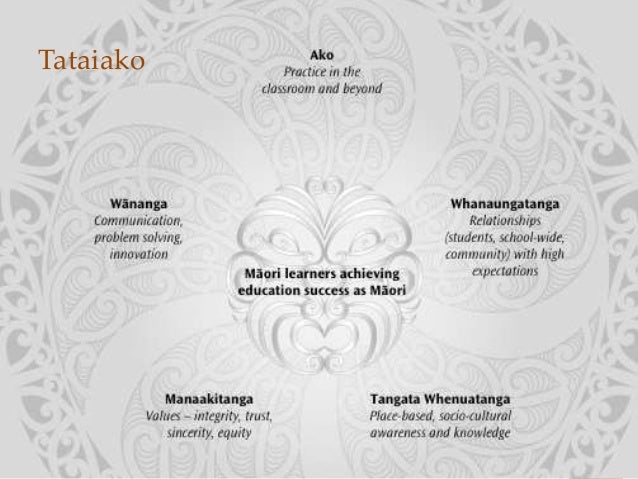
Using Pohatu’s (2011) Mauri model, I would place our school as mainly Mauri Oho – in a state of being proactive – while moving purposefully into Mauri Ora – actively engaged, commited and motivated. Most of us also incorporate meaningful culturally inclusive learning activities into our programmes through reo, art, tikanga, pepeha and waiata. We honour our commitment to the Kawanata through professional development and meaningful learning opportunities. We honour the Tataiako Competencies as we provide these meaningful experiences. 


Schoolwide, our principal leads a cultural focus every week at assembly where we fly the flag of one of the different nationalities within our school and find out facts about them. When possible the students from those countries are involved. We use an itranslate app on the ipad for our esol students. We welcome all new students and their whanau each term with a powhiri. We have a Matariki Week throughout our school, which culminates in a whanau hangi, prepared and celebrated by students, whanau and the school. We visit local marae  and learn about our local stories and culture. We have senior and junior kapa haka groups, involving hundreds of students, staff, tutors and whanau. Our school is well signposted in both languages.
 We are a future focussed school committed to success for all.


ERO review. Retrieved from http://www.ero.govt.nz/review-reports/taupo-school-22-11-2016/
Gay,G. (2002). Preparing for culturally responsive teaching. Journal of Teacher Education, 53(2),106-116.
Education Council. Tataiako. Retrieved from: https://educationcouncil.org.nz/sites/default/files/Tataiako.pdf

Thursday, 5 October 2017

Contemporary Trends

Focus on the Future


As this week's course material informs us, the world is changing at a staggering rate. It is as hard for me to believe some of the predictions outlined in the readings and videos, as it was for our parents to believe some of the technology in 'The Jetsons". But here we are - using personal communication devices, riding hoverboards and getting all the daily nutrition we need from a single tablet. 

When reading the OECD’s Trends Shaping Education 2016 , we are told that as the world becomes increasingly interconnected, urbanisation is increasing rapidly. With urbanisation comes increased risks such as overcrowding, financial crises, unemployment, crime, inadequate intrastructure, lack of fresh food and water, and so on. 

KPMG’s Global Megatrends animated infographic informs us that by 2030, 60% of the world will be living in cities, predictions rising to 70% by 2050. These are vast megacities with populations many times larger than that of our entire country. The OECD asks “Are cities the new countries?” Cities are now capable of self-sufficiency. They are becoming more generic for the convenience of those living in them and across them globally. If you were dropped in to a megacity blindfolded, would you immediately be able to tell if it was Shanghai or Chicago? It is only by travelling out of the cities that you will see the personality of a country begin to show.
People move to cities for many valid reasons: employment, education, healthcare, cultural diversity, etc. As these centres grow, so does the demand for services and products. Increased production of products and provision of services creates higher levels of pollution, waste and CO2 emissions. The hospitality industry alone is responsible for inconceivable amounts of food waste and single use plastic pollution. The KPMG video informs us that 80% of the entire world’s energy is consumed by cities, and they produce 80% of all emissions.

Cue future-focused education.

The focus of education is shifting from knowing the parts of a sentence and memorising the order of the planets, to being able to solve real life problems and collaborate with others to find solutions. The integration of 21st century skills and STEM subjects prepares our students for the potential risks of an overcrowded and demanding society. Most countries are now implementing programmes rich in Science, Technology, Engineering and Maths. Many are including creativity, critical thinking and innovation. In his Ted talk, Sir Ken Robinson  reminds us about the power of creativity, and how many ’highly talented, brilliant, creative people think they’re not, because the things they were good at at school wasn’t valued, or was actually stigmatised.’ So, I am more than happy for STEM to become STEAM and develop creativity of the Dreamer through the Arts and innovation.

Before I began Mindlab, I had never heard of the ITL rubrics, but I now find they are an integral part of my planning and discussions with my students. The World Economic Forum provides an extended and extremely useful list of skills, qualities of character and competencies.

How does this manifest itself in little old Taupo? Anyone who tries to travel across the control gates bridge from Nukuhau in the morning, or during the Christmas break, will attest that urbanisation has taken effect even in our small community, and our infrastructure is becoming woefully inadequate. The need for better roading and another bridge over the river was discussed, and even planned for, over a decade ago. Let’s scale that up to Hamilton and Auckland. The same discussions – roads and bridges. And this is in our tiny country of 4.5 million people?
KPMG states that keeping up with infrastructure is vitally important when addressing the potential risks associated with rapidly expanding urban centres.
A good start is with STEAM programmes in primary schools. Let the students build structures out of marshmallows and toothpicks or straws and newspaper – it might only support a ball today, but one day it could be a bridge or a housing complex. Encourage them to experiment with marble rolls. They could be tomorrow’s public transport systems. Your expert slime maker could be the roading surface expert of the future. 


Tuesday, 3 October 2017

Current issues in my professional context

Hooked On Learning


I proudly teach at Taupo Primary School. Our school is situated in the heart of the Taupo township. Being immediately visible to those new to the town, we attract many enrollments from transient and overseas families, as well as the children of people working in town and those who live in the vicinity.  Our school charter says that approximately 40% of the students are Maori and other ethnicities represented in the school population are Tokelauan, Chinese, Korean, South African, Samoan, Fijian, Japanese Philipino, Irish, English, Polish, Scottish and Australian, our roll fluctuating between 480 and 520 students.
We are a Decile 5 school.  
The Ministry of Education explains that: "Deciles are a measure of the socio-economic position of a school’s student community relative to other schools throughout the country.For example, decile 1 schools are the 10% of schools with the highest proportion of students from low socio-economic communities, whereas decile 10 schools are the 10% of schools with the lowest proportion of these students.A school's decile does not indicate the overall socio-economic mix of the school or reflect the quality of education the school provides."
We cannot be seen as a 'straight' decile 5. We are a real mix. We have many wealthy families from farming and professional backgrounds, and many families in minimum wage employment or who are unemployed. In the same way a teacher adopts a variety of strategies and teaching techniques to best suit the different personalities, achievement levels and learning styles of his/her class, our school has developed a broad set of strategies to create an inclusive culture and climate that honours and celebrates the rich cultural tapestry of our makeup. 
In 2016, the learning culture of our school was described by ERO as collaborative. In their report they state that our approach fosters positive relationships and contributes to mutual understandings about the needs of children from different cultural groups. The report adds, that we listen to parent’s ideas and work with them to better understand how to respond to the needs of children. “A friendly, supportive interaction is enjoyed within the school community. Families and whanau are welcome and encouraged to participate in students learning, and give a real sense of whangaungatanga within the school.”(ERO,2016)
In Stoll’s article on school culture, Stoll and Fink describe cultural norms that influence an improving school community:

 Our senior management team adopts all of these norms when planning strategically for our teachers and students. This is clearly reflected in our shared mission, which was developed in consultation and collaboration with staff, students and the community:

In a cultural melting pot such as ours, it has been important that we eliminate as much of the APA’s ‘subjective perceptions’ of social status and class as possible. By focusing on how we treat each other and building our shared beliefs (Mark Wilson) we have been able to put aside the sometimes negative influences that socioeconomic status (SES) can have in schools and just get on with the business of being us. Our entire school is able to talk about our vision: Hooked on Learning. Our school rule is Respect Self, Others and the Environment and our core values around RESPECT are visited and discussed every week at assembly. We are a PB4L school and we celebrate positive behaviour as well as our learning journey's together.
While I object to many of the assertions of the APA factsheet, they make a valid point relating to the issues that can arise due to the SES of a community. Students from lower SES families are less likely to have rich experiences to draw on, and often come to school with less oral language and topic specific vocabulary. This has a flow on to the development of their phonological awareness, writing and reading skills. This is a constant frustration to our teachers of junior students especially, and they do an incredible job of implementing rich learning programs specifically designed to develop oral language e.g. play based learning and the oral language boxes used in Perceptual Motor Programme.
I found the APA reading extremely challenging for a number of reasons. Statements like “Children in lower-income schools are less likely to have well-qualified teachers”, and “Students who were ... assigned to higher quality classrooms” do nothing but feed the negative perceptions of lower decile schools. While the spotlight is frequently on the negative impact lower SES has on educational achievement, I would like to address the positive aspects present in many lower SES schools. Having worked in a decile 2 school for 18 years, and in the East End of London before that, I can categorically state that my colleagues were/are the hardest working bunch of professionals I have ever worked with. The quality of education they deliver is second to none, because it has to be. In lower SES schools, relationships are everything. There is a degree of trust, empathy, encouragement and respectfulness between staff and pupils in lower SES schools that is lacking in higher decile schools I have taught in. Hardship often brings communities closer. 


Stoll. (1998). School Culture. School Improvement Network’s Bulletin 9. Institute of Education, University of London. Retrieved from http://www.educationalleaders.govt.nz/Culture/Understanding-school-cultures/School-Culture